Table Talk
Nothing here yet. Love this design? Say so - the designer might see it.
Log in to join the conversation.
Mini Backgammon
Miniatures
Free
Plan Your Print
Sign in
to track this print from Want to Printed.
✓Needs about 92 g
From the designer's print profile
✓Optional multicolor profile
The designer also offers a multicolor way to print this (an MMU/AMS profile or per-color parts)
What it takes
3 plates
3h 16m
92 g PLA
A1, H2S, H2D, X1E, P1S, X1 Carbon, P2S, X1, H2C, H2D Pro, P1P, X2D, A2L
Plate Details (3)
0.4 mm nozzle, all plates
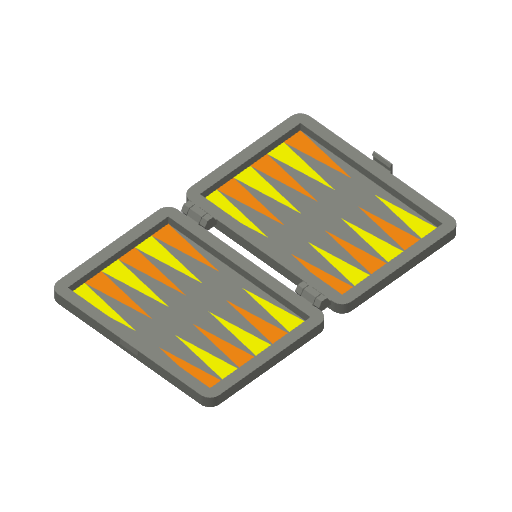
Plate 1 · Game Board
2h 32m
84 g
PLA · 69 g
PLA · 8 g
PLA · 7 g
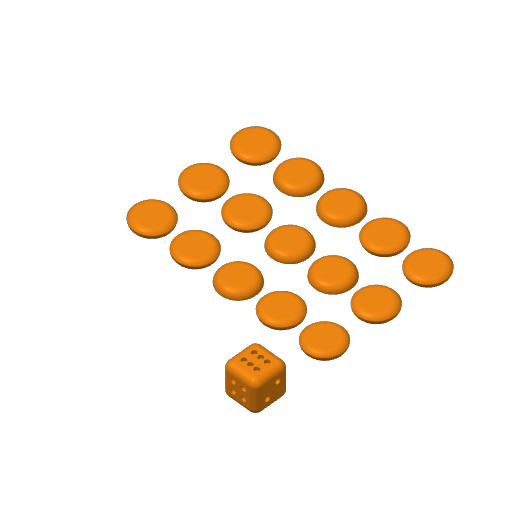
Plate 2 · Game Pieces Orange
22m
4 g
PLA · 4 g
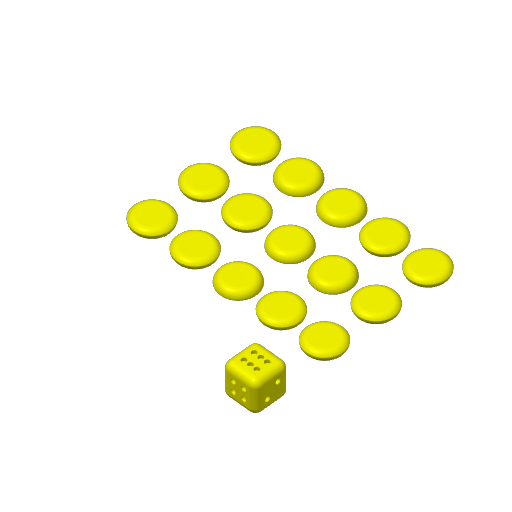
Plate 3 · Game Pieces Yellow
22m
4 g
PLA · 4 g
Model Description
3D Printed Travel Backgammon Game (Print-in-Place)
This is a compact, travel-size backgammon game designed to be fully 3D printed.
The board is foldable with print-in-place hinges , making it easy to carry and store.
It’s my first more or less complex 3D printing project , and I wanted to create something functional, portable, and beginner-friendly.
The model includes:
- Foldable backgammon board
- Checkers
- Two dice
Perfect for taking on trips, to cafés, or just keeping in your bag for a quick game 🎲
Features
- ✔ Print-in-place hinges (no assembly required)
- ✔ Travel size design
- ✔ Beginner-friendly print
- ✔ Clean, simple layout
- ✔ Open Source – feel free to remix and improve
Printing Information
- Printer: Bambu Lab A1 (with AMS)
- Material: PLA Basic
- Slicer: Bambu Studio
- Settings: Standard Bambu Studio settings
- Supports:
- Required for the hinges
- Assembly:
- None — the hinges are fully print-in-place
- You may need to gently move the hinges after printing to loosen them
This model is suitable for beginners , as long as supports are enabled correctly for the hinges.
Notes
- After printing, carefully flex the hinges to ensure smooth movement.
- If you experience tight hinges, gently work them loose by hand.
How to Play (Backgammon Basics)
Backgammon is a two-player game where each player tries to move all of their checkers off the board before their opponent.
Setup
- Each player has 15 checkers .
- Players sit opposite each other.
- The board consists of 24 triangles (points) .
- Players move in opposite directions.
Objective
Move all your checkers into your home board and then bear them off (remove them from the board).
Movement
- Each turn, roll two dice .
- Move your checkers according to the numbers rolled.
- You can split moves across different checkers.
- Rolling doubles lets you play the numbers four times .
Hitting
- If a point has only one opponent checker , you may land on it and hit it.
- The hit checker goes to the bar and must re-enter before any other moves.
Bearing Off
- Once all your checkers are in your home board, you can start bearing off.
- The first player to bear off all checkers wins the game .
/pic1564242.png)
/pic5467885.jpg)