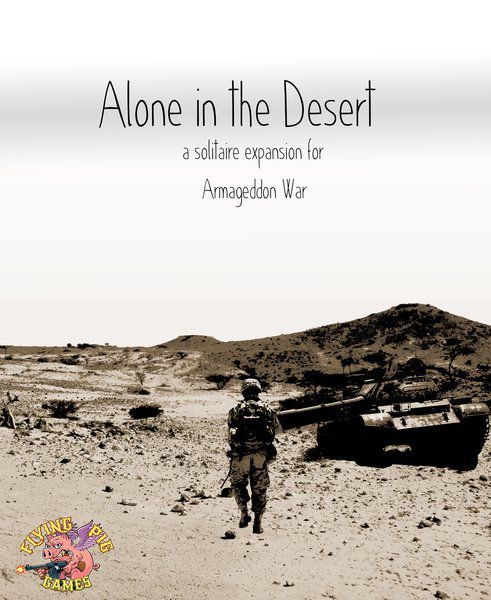
Alone in the Desert: a solitaire expansion for Armageddon War 2018
Expansion of Armageddon War: Platoon Level Combat in the End War
Location
Sign in to see where your copy sits: the shelf, drawn, and how the box sits on it.
My Copy & Notes
My Prints for Alone in the Desert: a solitaire expansion for Armageddon War
All 0 on LayerUpSign in to see the prints you marked Printed for this game, the insert in the box first.
Expansions & Promos
No expansions or promos on record for this game.
About the Game
The expansion includes rules for playing Armageddon War solitaire, six solitaire scenarios in a loose campaign, counters and cards.
Each hex of enemy units in a solitaire scenario will have a “stance” counter, “aggressive”, “cautious” or “defensive”. When an enemy formation activates, each hex of units will draw a card and act according to the keywords on the card. These are shorthand and more fully delineated in the solitaire rules, but you can get a feel for them from the card. For instance, “Close(2)” means close 2 hexes with the nearest appropriate enemy unit (if “close” is in gold you close with armor, red is infantry). “Cover” would mean movement that utilizes available cover instead of open terrain, and the way you would decide is covered in the rules. Fire would be at the appropriate armor or infantry target, and so on.
On the player turn, the player draws a card each time a unit declares a movement, to see if an AI unit declares opportunity fire, and when that opportunity fire happens. For instance, “Strongest(1)” would mean that of all the AI units which can see your unit after it moves 1 hex, the strongest one able to opportunity fire does so. Tie-breaker situations are covered in the rules to determine who does it. For instance “Strongest(1)” would have a tie-breaker of "Color-Closest", so if two possible Opfire units had the same firepower, you would check to see if one had the same color firepower as the defense type (armor vs. armor, infantry vs. infantry), and if still tied, then the closer of the two would make the attack.
—description from the publisher
Filed Under
- Categories
- Mechanics
- BGG ratings
- 32 · geek rating 5.53