Location
Sign in to see where your copy sits: the shelf, drawn, and how the box sits on it.
My Copy & Notes
My Prints for Avalancha
All 0 on LayerUpSign in to see the prints you marked Printed for this game, the insert in the box first.
Expansions & Promos
No expansions or promos on record for this game.
About the Game
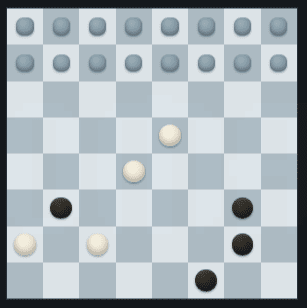
Avalancha is a two-player strategy game about a board that only ever gets more crowded. It starts with two rows of neutral pieces filling one edge, with a further supply held in reserve off to the side. Those neutral pieces only ever move in one direction — toward the opposite edge of the board — and as the reserve feeds new pieces in, the total number of them on the board keeps growing over the course of the game. Each player also has four pawns, placed on random squares in the lower part of the board at the start, so the starting position is different every game.
On your turn you do two things, in order: move one of your own pawns like a chess queen (any distance, straight line, through empty squares), and then move any neutral piece the same distance in its one fixed direction. That second move isn't optional — if no neutral piece can legally travel that exact distance, your pawn move isn't legal either, so you have to pick something else. Because you get to choose which neutral piece moves and where it ends up, this isn't just bookkeeping: it's a real decision that can either support your own pawns or box in your opponent's.
A pawn is removed from the game the moment it has no open squares left among its eight neighbors — it's simply taken off the board, permanently. Since neutral pieces never leave the board once placed, only accumulate, positions naturally get tighter as the game goes on, and pawns that don't manage their space well eventually get boxed in and removed.
You win by being the last player able to make a legal move. A player loses once they either have no pawns left, or none of their remaining pawns has any legal move paired with an available matching neutral-piece move.
—description from the designer
Filed Under
- Categories
- Mechanics
- BGG data
- refreshed Oct 16, 2026
- On LayerUp since
- Oct 16, 2026