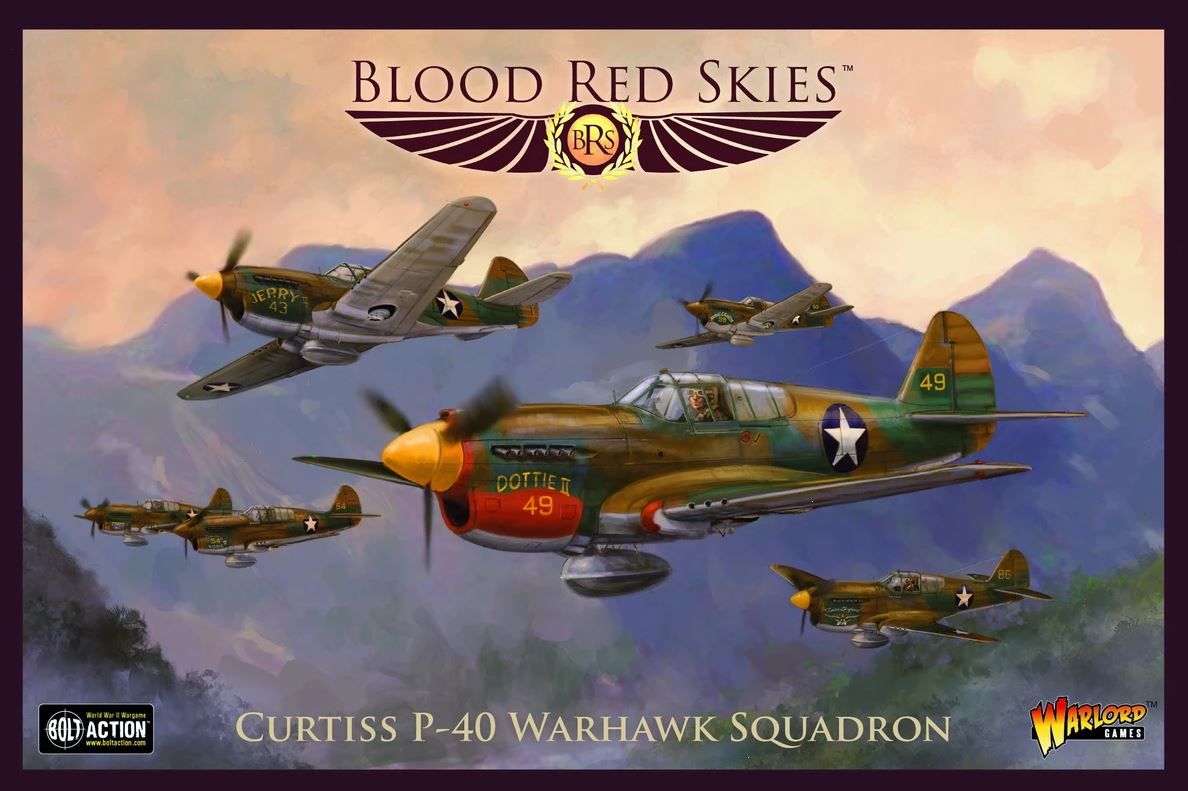
Blood Red Skies: Curtiss P-40 Warhawk Squadron 2020
Expansion of Blood Red Skies: Battle of Britain
Location
Sign in to see where your copy sits: the shelf, drawn, and how the box sits on it.
My Copy & Notes
My Prints for Blood Red Skies: Curtiss P-40 Warhawk Squadron
All 0 on LayerUpSign in to see the prints you marked Printed for this game, the insert in the box first.
Expansions & Promos
No expansions or promos on record for this game.
About the Game
The Curtiss P-40 Warhawk is an American single-engined, single-seat, all-metal fighter and ground-attack aircraft that first flew in 1938. Used by most Allied powers during World War II, it would see service throughout the war. It was the third most-produced of US aircraft of WW2, behind the P-51 and P-47 - with 13,738 examples produced.
Its first combat was with the British Commonwealth of the Desert Air Force over North Africa and the Middle East. Whilst Warhawk was the name utilised by all USAAF and USAAC units that employed the aircraft, other Allies used the name Tomahawk or Kittyhawk to refer to specific variants. It was thus a Commonwealth Tomahawk of No. 112 Squadron of the RAF that first adopted the iconic "shark mouth" design on an Allied aircraft.
The main theatres of operation for the P-40 were North Africa, the Southwest Pacific and China, though it also served significantly in the Middle East, Southeast Asia, Eastern Europe, Alaska and Italy. The P-40 was not especially effective at high-altitude combat, where it could be outclassed by both the Messerschmitt BF109 and the Focke-Wulf 190. It excelled at lower altitudes, however, performing as an air superiority fighter, bomber escort and fighter-bomber.
The aircraft's low production cost kept it relevant throughout the war. Though it began to develop a reputation as a mediocre design later in the war, it performed well throughout. If wartime victory claim records are to be believed, the aircraft produced over 200 Allied fighter aces (from 7 different nations), including at least 20 double aces.
—description from the publisher
Filed Under
- Categories
- Mechanics
- BGG ratings
- 6