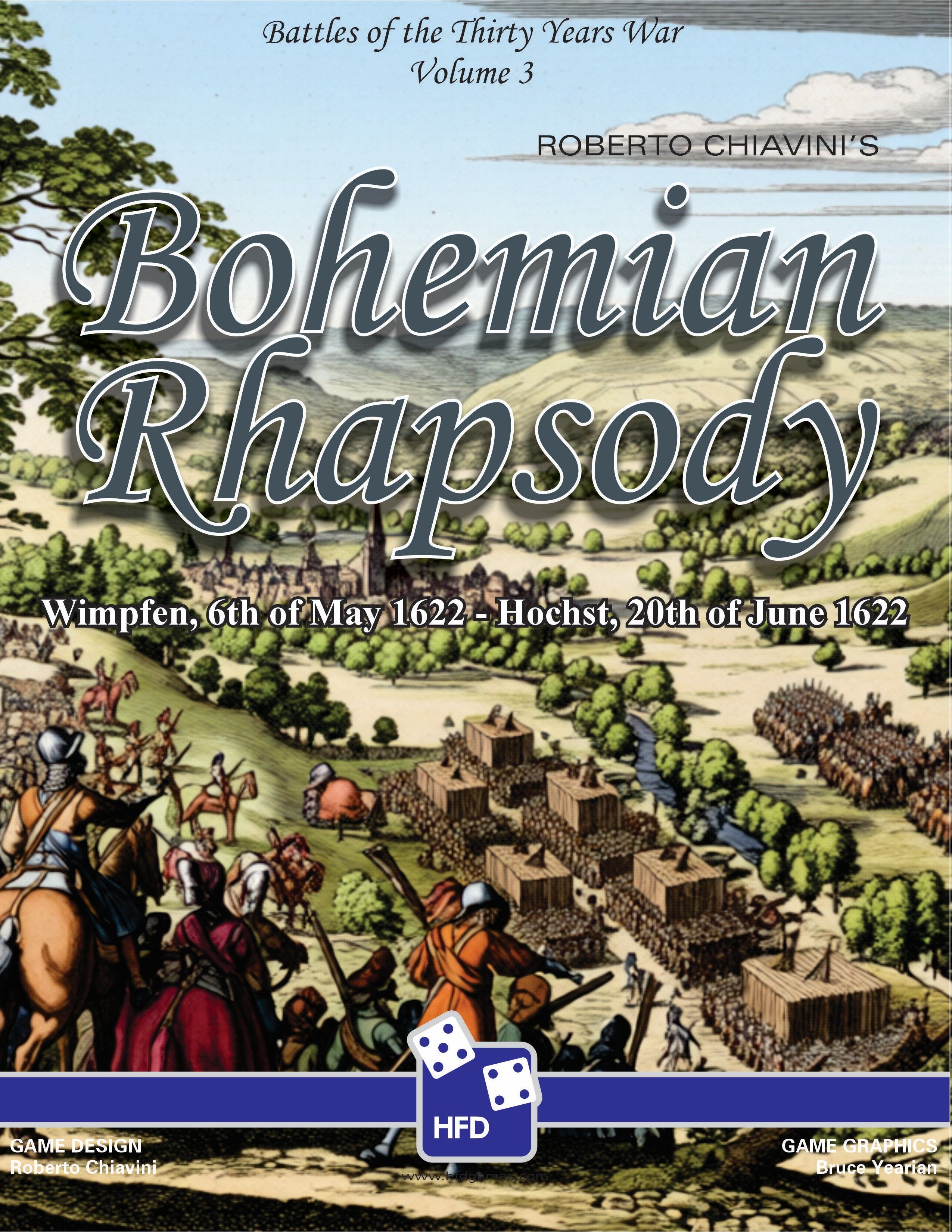
Bohemian Rhapsody: The Battles of Wimpfen And Hochst, 1622 2026
Location
Sign in to see where your copy sits: the shelf, drawn, and how the box sits on it.
My Copy & Notes
My Prints for Bohemian Rhapsody: The Battles of Wimpfen And Hochst, 1622
All 0 on LayerUpSign in to see the prints you marked Printed for this game, the insert in the box first.
Expansions & Promos
No expansions or promos on record for this game.
About the Game
Both battles were part of the so called “Bohemian phase” of the Thirty Years War and the results of Wimpfen led to the battle of Hochst. The first took place when the Catholic forces of Tilly and Cordoba surprised the smaller force of George Fredrick of Baden who was trying to cross the river Neckar near Wimpfen.
Even if the Protestant forces made their best in the battle, thanks to a favorable uphill position, they were defeated. A month and a half later, another part of the Protestant army moving around the Rhineland, the portion commanded by Christian of Brunswick, was stopped by the same Catholic army under Tilly and Cordoba near the town of Hochst, while trying to cross the river Main. The ensuing battle was a sort of a draw, as at least a part of the Catholic army was able to join another Catholic force under Mansfeld, but at so high a cost in losses, that the Palatinate theatre of the war was de facto closed.
Players will also need one six-sided die (D6) and an opaque container (mug, envelope or anything similar) to play the game.
Each combat unit represents from 300 to 1000 soldiers, and it is rated, from left to right, for combat morale and movement. Each infantry strength point is around 150 men, each cavalry strength point about 60 men. Each leader is rated for Command (indicating how many activation chits that leader has) and Movement. Each hex is about 100 meters. Each turn represents a half hour of time.
—description from the designer
Filed Under
- Categories
- Mechanics
- BGG data
- refreshed Oct 16, 2026
- On LayerUp since
- Oct 16, 2026