Location
Sign in to see where your copy sits: the shelf, drawn, and how the box sits on it.
My Copy & Notes
My Prints for Cam
All 0 on LayerUpSign in to see the prints you marked Printed for this game, the insert in the box first.
Expansions & Promos
No expansions or promos on record for this game.
About the Game
Cam is a small but not tiny game of sudden death. This little abstract ends as soon as one player gets any one piece to the single goal space at the opposite end of the board. To do so, one has to get past the opponent's pieces.
Each player has two types of pieces which mostly move similarly. One can jump one's own pieces or jump to capture an opponent's. Multiple jumps in any direction are allowed. So, sudden reversals and leaps to victory are not uncommon. Since only one piece in the goal is needed to win, this game can be unforgiving. Still it's quick and many games can be played in one sitting.
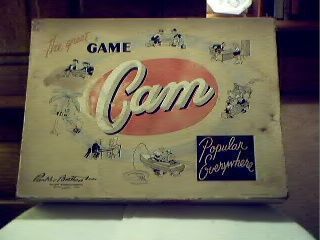
Cam, released by Parker Brothers in 1949, is a down-sized version of Camelot.
Cam is different than Camelot in the following ways:
The Cam board has 67 squares. The Camelot board has 160 squares. Each side in Cam has two Knights and five Men. Each side in Camelot has four Knights and ten Men. The object of Cam is to get one piece into the opponent's Castle. The object of Camelot is to get two pieces into the opponent's Castle. Victory in Cam also occurs if one side, even with only one remaining piece, captures all of the opposing pieces. In Camelot, if the side capturing all of the opposing pieces has only one remaining piece, the game is a draw. Victory in Camelot by capture of all of the opposing pieces occurs only if the victorious side has two or more remaining pieces. Stalemate in Cam is impossible. Stalemate in Camelot is possible, and is a victory for the stalemating side if it has two or more pieces. In Cam, if both sides have only one remaining piece, the game continues until one piece captures the other, or one piece enters the opposing Castle. In Camelot, if both sides have only one remaining piece, the game is a draw.
Re-implements:
Chivalry Camelot
Filed Under
- Categories
- Mechanics
- BGG ratings
- 14