ChemiX 2011
Location
Sign in to see where your copy sits: the shelf, drawn, and how the box sits on it.
My Copy & Notes
My Prints for ChemiX
All 0 on LayerUpSign in to see the prints you marked Printed for this game, the insert in the box first.
Expansions & Promos
No expansions or promos on record for this game.
About the Game
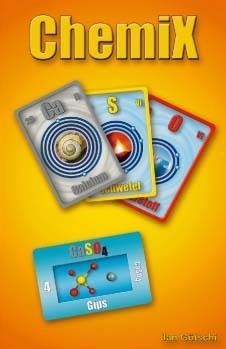
The United Nations dubbed 2011 the International Year of Chemistry, and to aid in the understanding of this science Swiss publisher Murmel has released ChemiX, a collection of two card games: one in which players try to create various chemical compounds, and another in which players try to void their hand.
At the start of "ChemiX Classic", each player receives a noble gas card and three cards from a deck of element cards, which include hydrogen, oxygen, nitrogen, calcium, iron and more. Forty-two connection cards are laid face-up on the table (grouped as desired by the players), along with multipliers of value 2, 3 and 4.
On a turn, a player can play cards from his hand to create any of the connections on a card. The player can simultaneously rearrange cards on the table to create new compounds, using the multiplier cards as needed to create molecules like O2 or H2O. If you leave element cards on the table, you must pick them up, but your hand limit is three cards; should you need to pick up more, those extra cards will count against you at the end of the game. A player's score is the sum of compound cards claimed and noble gas cards collected, minus penalties from dead cards collected during play.
The second game is "Chemuno", with all of the cards being shuffled together and each player receiving a hand of seven. The first player lays a card on the table; the next player must lay down a compound, element or multiplier that "matches" this first card. (A compound must use an identical element as a compound on the table or use the element or multiplier present, and so on.) If the previous card was a multiplier, the next player must draw 2-4 cards (equal to the mutiplier value) unless she can play the same multiplier herself, thereby doubling the penalty for the next player. The first player to run out of cards wins.
Filed Under
- Categories
- BGG ratings
- 6
- BGG data
- refreshed Jul 21, 2026