Churn 2024
Location
Sign in to see where your copy sits: the shelf, drawn, and how the box sits on it.
My Copy & Notes
My Prints for Churn
All 0 on LayerUpSign in to see the prints you marked Printed for this game, the insert in the box first.
Expansions & Promos
No expansions or promos on record for this game.
About the Game
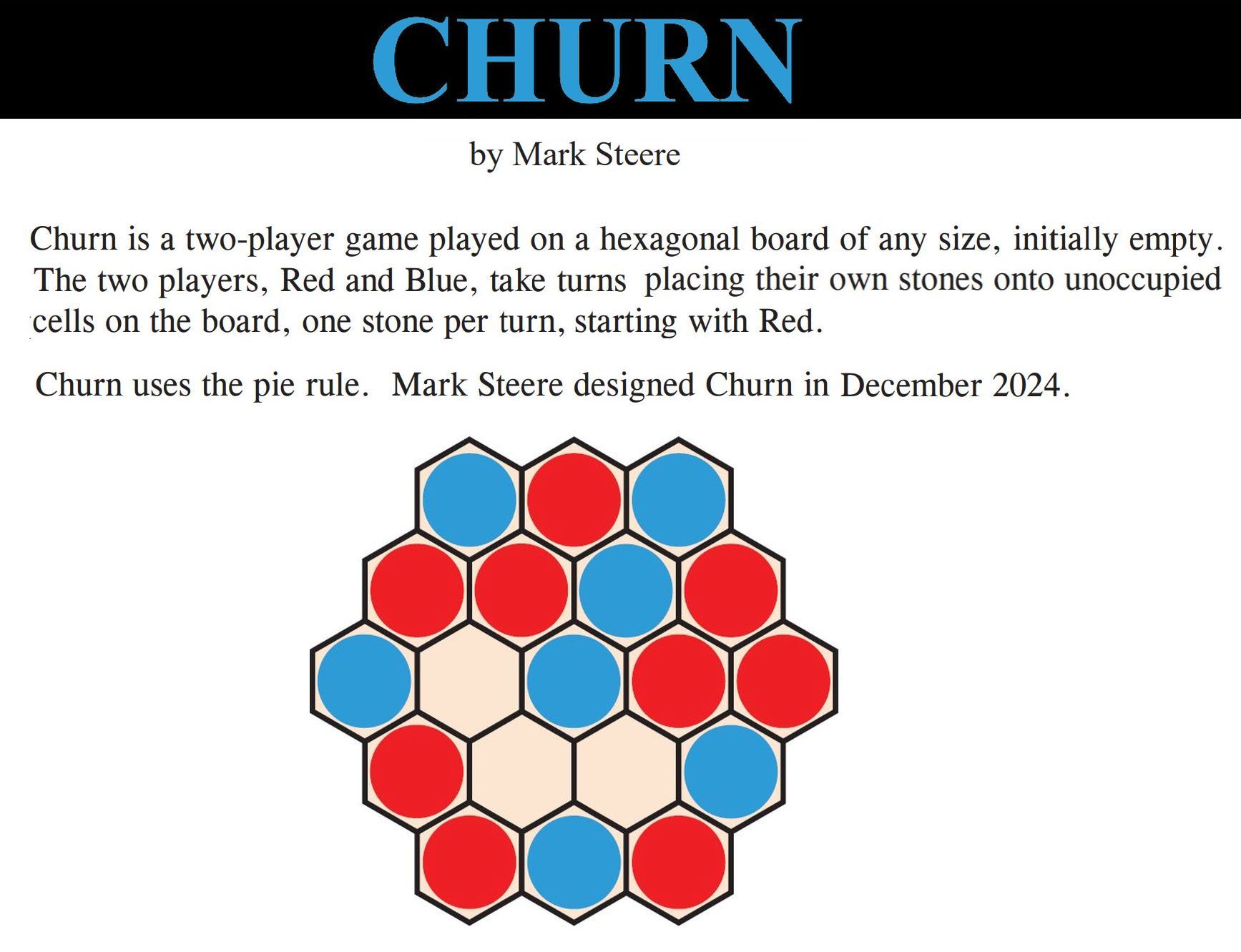
Churn is a two-player game played on a hexagonal board of any size, initially empty. Size 3 (side length 3) is recommended. The two players, Red and Blue, take turns placing their own stones onto unoccupied cells on the board, one stone per turn, starting with Red. Churn uses the pie rule.
PlayIf you can place a stone in isolation (not adjacent to any friendly groups), you must do so. If you can only place adjacent to a friendly group, you must select a placement that forms the smallest friendly group possible. A "group" here is a monocolored group of at least one stone.
Having placed adjacent to a friendly group, thereby forming a larger group, you must immediately remove all friendly groups smaller than the group so formed, concluding your turn.
Once the board has filled, at the conclusion of a turn, the player having the majority of on-board stones wins. (If your placement causes the board to be filled, you still have to finish your turn by removing all friendly groups smaller than your newly formed group.)
Design notesChurn was designed to have an extreme churn rate. For example, it takes about 7,400 turns to complete a game of Churn on a size 5 board (61 cells). It would take about 950,000 turns to complete a size 7 (127 cells) game of Churn. But like all MSG games (except for my first game, Quadrature, from 1992), Churn is naturally finite. Play can’t go on forever.
Irregular hexagonal boards can be used, such as one having side lengths 3,4,3,4,3,4 (27 cells). Only boards with an odd number of cells should be used, to prevent ties.
Filed Under
- Categories
- Mechanics
- BGG ratings
- 50 · geek rating 5.48
- BGG data
- refreshed Sep 7, 2026