Dipole 2007
Location
Sign in to see where your copy sits: the shelf, drawn, and how the box sits on it.
My Copy & Notes
My Prints for Dipole
All 0 on LayerUpSign in to see the prints you marked Printed for this game, the insert in the box first.
Expansions & Promos
No expansions or promos on record for this game.
About the Game
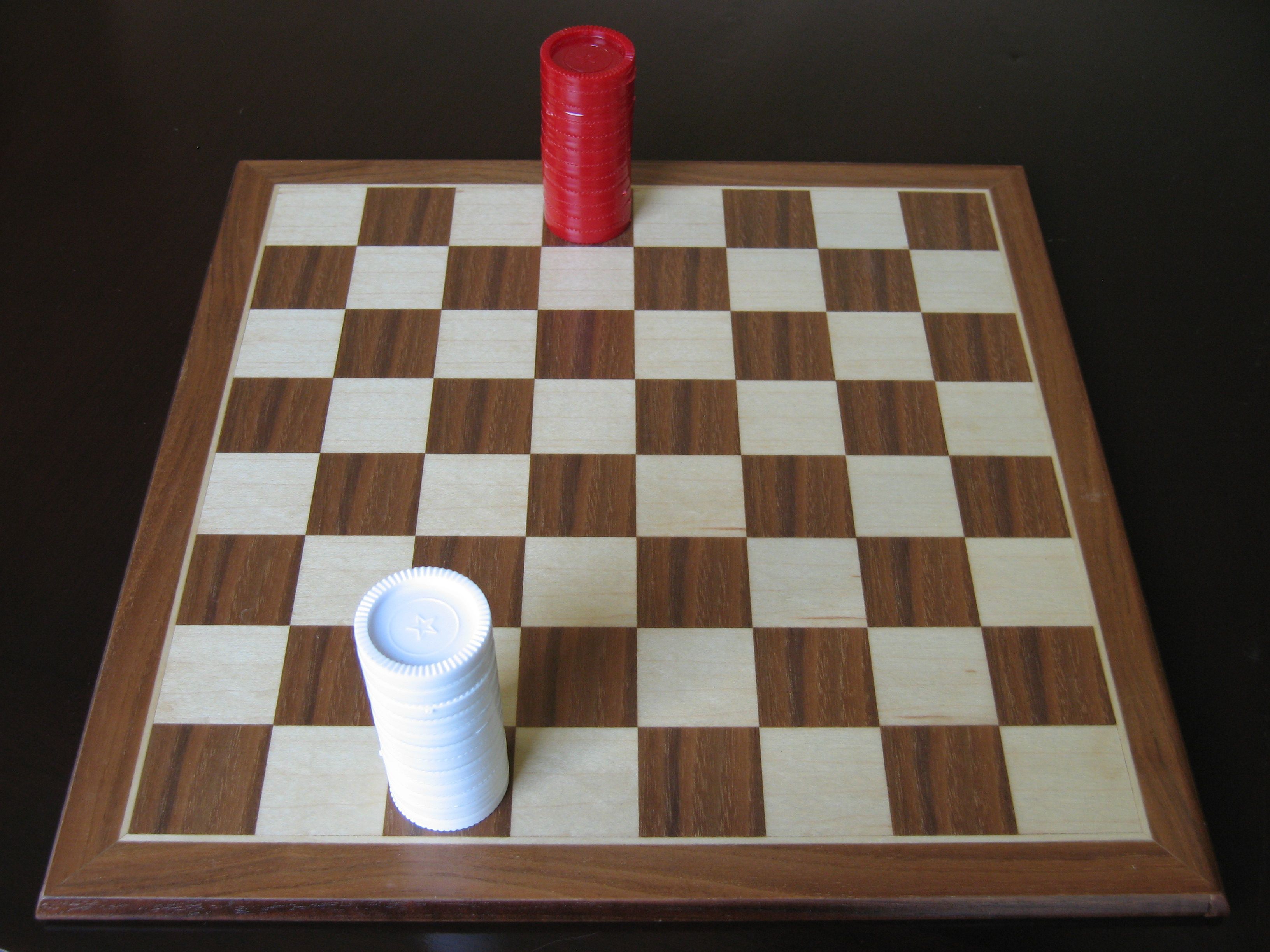
Dipole is played with a Checkers set. Only the dark squares are used. There should be a dark square in your lower left corner.
The game starts with two stacks of 12 checkers, one white and one black. More advanced players may elect to play Dipole on a 10x10 board with two stacks of 20 checkers, one in each player’s nearest row.
Use a coin (such as a nickel) to represent five checkers. So for example, a stack of two checkers with a coin on top would be equivalent to a stack of seven checkers.
To win, all of your opponent’s checkers must be removed from the board. Draws are not possible.
Basic movesPlayers take turns moving stacks of their own checkers, one stack per turn. You can move an entire stack or just a portion of one (also called a stack here). This holds true for merging and capturing moves as well. See below. Basic moves can only be made in the forward or diagonally forward directions.
The number of squares a stack is moved must equal the number of checkers in the moved stack. This holds true for merging and capturing moves as well. Even though only the dark squares are used, white squares must be included in the count.
If you move a stack out of bounds, you must remove that stack from play. When moving a stack out of bounds pretend the board squares extend outward far beyond the boundaries, and make a basic move accordingly. Stacks can only be removed in the forward or diagonally forward directions. Players typically remove singletons from their far row because they have nowhere else to go.
If you have no moves available, you must sit the game out until you do have a move available. If you have any moves available, you must move. There will always be a move available to one player or the other.
Merging movesStacks can be moved onto other, like-colored stacks. Stack movement is never obstructed by intervening stacks, regardless of size or color. This holds true for basic and capturing moves as well. Merging moves can only be made in the forward or diagonally forward directions.
Capturing movesCapturing moves can be made in any of eight directions. A stack can capture only an entire enemy stack, which must be of an equal or smaller size than the capturing stack. Basic, merging, and capturing moves must be made in a straight line.
Filed Under
- Categories
- Mechanics
- BGG ratings
- 49 · geek rating 5.51
- BGG data
- refreshed Sep 7, 2026