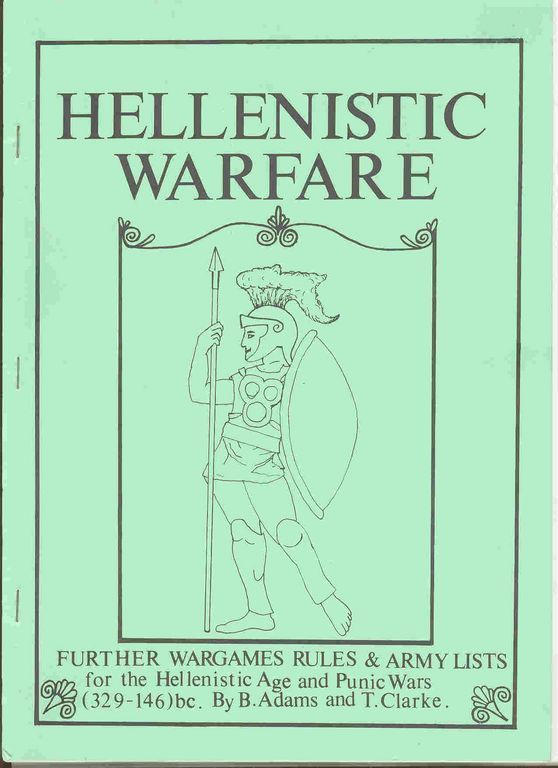
Hellenistic Warfare 1980
Expansion of Hoplite Warfare
Location
Sign in to see where your copy sits: the shelf, drawn, and how the box sits on it.
My Copy & Notes
My Prints for Hellenistic Warfare
All 0 on LayerUpSign in to see the prints you marked Printed for this game, the insert in the box first.
Expansions & Promos
No expansions or promos on record for this game.
About the Game
Hellenistic Warfare (329-146BC) table top miniatures rules
This is designed as a supplement to Hoplite Warfare, to extend the latter’s time period from its rather vague end—point at some point in Alexander’s campaign in Persia to 146 B.C. when, with the destruction of the cities of Carthage and Corinth, Rome stamped her authority over the Mediterranean world. So to use this booklet you also need Hoplite Warfare.
The political and military history of this period is set on a great canvas. In the Eastern Mediterranean the armies of great monarchies replace the small wars of Greece, and the Greek cities band together into political leagues in an attempt to match these large kingdoms; while in the West, was Rome’s vast struggle against Carthage. Finally Rome faced the Hellenistic kingdoms and the Greek Leagues; those that opposed her, one by one succumbed.
This was one of the great ages of scientific warfare. In the Hellenistic world armies of professional soldiers were led by generals who knew their business, the founders of the great kingdoms being, as it were, schooled by Alexander. Roman generals usually incompetently led soldiers whose length of service made them equally professional. The Carthaginians relied almost totally on professional mercenary soldiers.
Despite initial apprehensions, it was found that the modifications needed to simulate this period were not huge. The changes that have been made are an increase in armor classes to cover more heavily equipped cavalry, some changes to morale to cover the effect of elephants, shooting is modified to cater for the Roman pilum (as is hand—to—hand combat), the system for catering with unformed and disorganized troops is changed and the major addition, rules to simulate elephants. The training classes are slightly altered and rules added to simulate cavalry dismounting to fight as infantry “taking the Omens” is catered for.
Filed Under
- Categories
- Mechanics
- BGG ratings
- 1