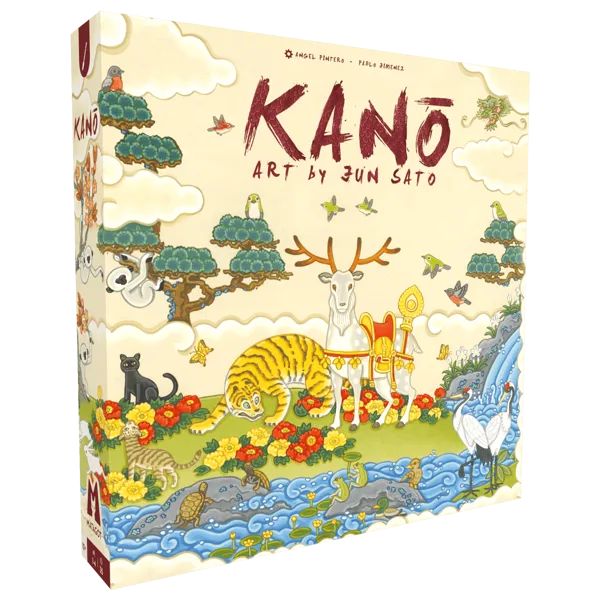
Kano 2026
Location
Sign in to see where your copy sits: the shelf, drawn, and how the box sits on it.
My Copy & Notes
My Prints for Kano
All 0 on LayerUpSign in to see the prints you marked Printed for this game, the insert in the box first.
Expansions & Promos
No expansions or promos on record for this game.
About the Game
In Kano, 2 to 4 players compete to create their own Emakimono—traditional Japanese painted handscrolls—by skillfully arranging vibrant paint pots. The game elegantly blends tactical resource management with spatial optimization as players navigate a shared central mat to collect the pigments needed for their masterpieces.
Gameplay Mechanics: Precision and Patience Each turn, artists must make meaningful choices to fill their scrolls:
Manipulate the Palette: Players may swap adjacent paint pots on the central mat to set up the perfect move. Pigment Collection: You must take at least one paint pot, but may take several if they are the same color and adjacent in a single row or column. The Rule of Gravity: When placing paint on your board, pots always "fall" to the lowest available space in a column, requiring careful planning to form specific patterns. The "Dry Paint" Limit: Artists must be efficient; if you end a turn with more than four visible paint pots on your board, the excess must be converted into "Cloud" tiles, which fill space but score no points.
Achieving Prestige Once a pattern is formed, players replace their paint pots with beautiful Artwork Tiles. Points are awarded based on the complexity of the creations:
Standard Artworks: Larger pieces earn higher scores, with 3-space artworks yielding 7 points. Personal Masterpieces: Players hold secret Masterpiece cards worth a significant 12 points each upon completion. The Shogun’s Demands: Common "Red" and "White" goal sheets provide shifting objectives every game, rewarding those who can adapt their style to meet specific artistic requirements.
The game reaches its climax when one player completely fills their board, triggering a final round of scoring to determine the Master Artist.
—description from the publisher
Filed Under
- Mechanics
- BGG ratings
- 230 · geek rating 5.63
- BGG data
- refreshed Sep 7, 2026