Location
Sign in to see where your copy sits: the shelf, drawn, and how the box sits on it.
My Copy & Notes
My Prints for Mah-Jongg Card Game
All 0 on LayerUpSign in to see the prints you marked Printed for this game, the insert in the box first.
Expansions & Promos
No expansions or promos on record for this game.
About the Game
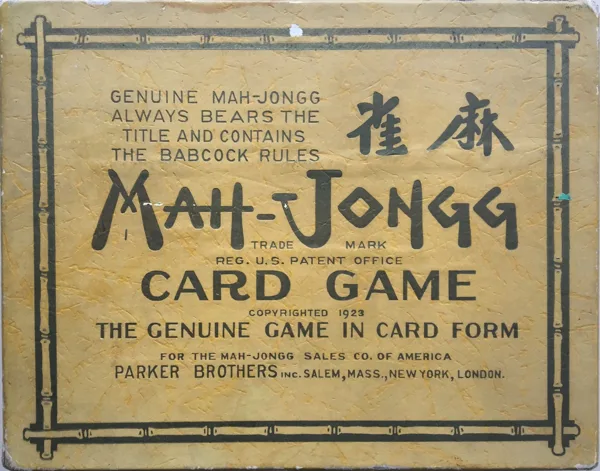
This 1923 publication was designed to transform Babcock Rules Mah-Jongg into a card game. (As the rules book notes, Mr. J. P. Babcock "originated the name Mah-Jongg, adapted all that was best of the Chinese forms of play, and added the Arabic numerals".) The rule book credits Douglas Lawson for having "correlated" the Babcock rules with card play.
The 164-card deck replicates the mix of tiles in the classic game. It includes four cards for 1-9 for each of the three suits (Dots, Bamboo, Characters), as well as four each of the North, South, East and West winds and Red, Green and White Dragons, plus the 8 Flower cards. As in the classic rules, players try to collect sets or 3 or 4 of a kind or in a sequence, with bonuses for various combinations and special tiles.
Instead of ivory or bone scoring sticks, the card game uses thin colored wooden rods for scoring. The game includes 40 short green sticks worth 2 each, 32 medium-length yellow sticks worth 10, 36 longer red sticks worth 100, and 8 long blue sticks worth 500.
While the rule book focuses on the Standard and Royal games for four players, it does include variant rules for 3, 5 and 6 players. (The Babcock rules were largely superceded in North America in the 1930s by American Mah-Jongg rules.)
Filed Under
- Categories
- Mechanics
- BGG ratings
- 5
- BGG data
- refreshed Sep 7, 2026