Location
Sign in to see where your copy sits: the shelf, drawn, and how the box sits on it.
My Copy & Notes
My Prints for Màoyìzhīlù
All 0 on LayerUpSign in to see the prints you marked Printed for this game, the insert in the box first.
Expansions & Promos
No expansions or promos on record for this game.
About the Game
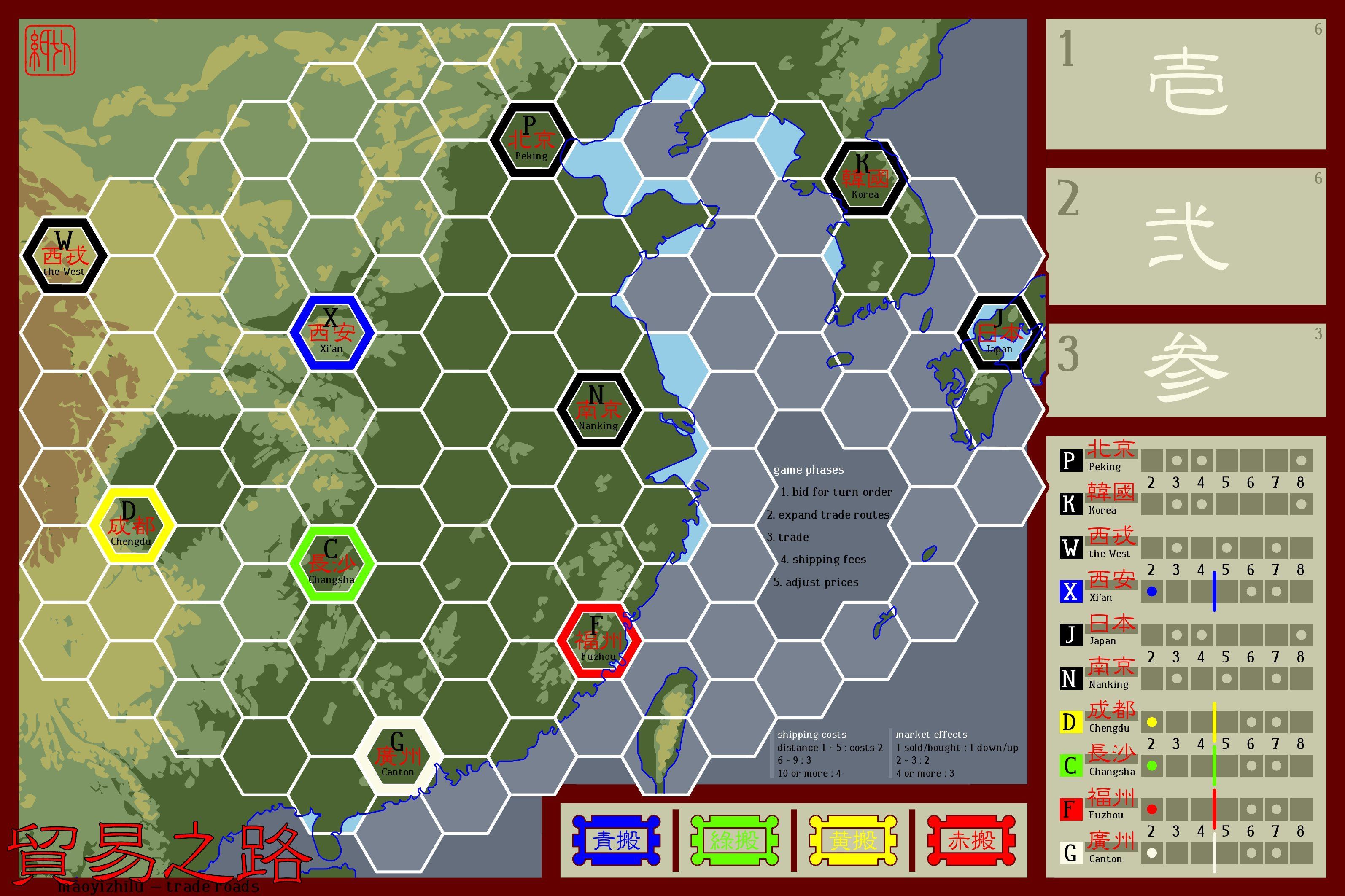
貿易之路 (Màoyìzhīlù - trade roads) is an economic game set in Silk road era China. It is more a game about economics and game theory than about China and its neighbors, however. Routes in 貿易之路 (Màoyìzhīlù - trade roads), the 'trade roads' of the title are chains of trading posts / inns etc. that you as a merchant can choose to use. All trade roads can be used by all players. Shipping fees are payed to the 'shipping company' that controls that trade road. There's shipping by sea as well, which works a tiny little bit differently.
The players, rich merchants, decide which shipping company invests where and how. They do this by buying cubes of the color of that shipping company. The cubes bought can be put on the map as sections of trade roads (or harbors), or they can be kept in the player's stock as 'influence' in that shipping company. The profits of a shipping company are divided by ratio of such influence cubes. Hence, owning more cubes means a larger share of the profit. However, a shipping company can only make a profit if it has many trade roads, many cubes on the map. Therefore, cube hoarders get a large share of nothing, and a player that spends all his cubes on roads gets a tiny share or even nothing of - potentially - a lot.
Of course, the profit a shipping company makes is entirely dependent on whether the roads (and harbors) of that company are actually used. Players decide what to ship from what location to what other location. Of course, the choice is driven by profit maximization. There are 10 locations on the map. 7 of these are Chinese cities. The other 3 are foreign locations. In all locations, three (out of five total) goods are traded. Prices are set randomly at the beginning of the game, but after that they depend on trade. Buying goods in a market makes the price of that good increase. Selling goods in a market makes the price of that good decrease.
And, rather importantly, all players (secretly) plan their trades at the same time. Plans are revealed simultaneously, and then carried out one after the other. Only after all players have made their trades, the market prices change.
Filed Under
- Categories
- Mechanics
- BGG data
- refreshed Jul 17, 2026