Obelisk 2013
Location
Sign in to see where your copy sits: the shelf, drawn, and how the box sits on it.
My Copy & Notes
My Prints for Obelisk
All 0 on LayerUpSign in to see the prints you marked Printed for this game, the insert in the box first.
Expansions & Promos
No expansions or promos on record for this game.
About the Game
Obelisk is a 2-player, draw-less area-control game played on a 7x7 grid of 49 spaces, using 48 Reversi/Othello pieces and one Obelisk piece. Adjacent means orthogonally or diagonally touching. A queen move is straight-line movement, any distance, as in chess.
To set up, place the Obelisk one space off the board's exact center (row 3, column 4 on a board numbered 1-7 in each direction, rather than dead center at row 4, column 4), then decide who moves first.
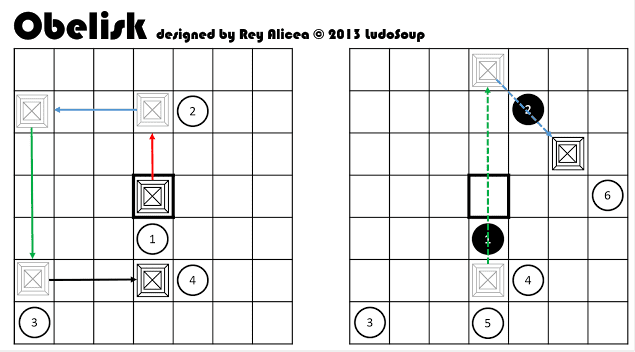
Each turn is two actions. For each action, the player chooses one of two types. Retreat: place a white-side-up Reversi piece on an empty space adjacent to the Obelisk, then move the Obelisk as a queen move along that same line in the opposite direction, any distance, to an empty space. Approach: place a white-side-up piece on an empty space that's in a completely clear line of sight from the Obelisk, at least two spaces away, then move the Obelisk along that same line toward the piece, stopping on the empty space right next to it.
While moving, the Obelisk may pass over any number of white pieces, flipping each to black as it goes, but it can never pass over a black piece, which blocks it completely in that direction. The Obelisk must move at least one space and always land on an empty square.
The game ends the instant no legal action remains for either action type. Whoever made the last move wins; their opponent, unable to act, loses. Since neither piece color belongs to either player, this can happen after just one action of a turn, not only after a full two-action turn.
Filed Under
- Categories
- Mechanics
- BGG ratings
- 2
- BGG data
- refreshed Sep 5, 2026