Pharao 1984
Location
Sign in to see where your copy sits: the shelf, drawn, and how the box sits on it.
My Copy & Notes
My Prints for Pharao
All 0 on LayerUpSign in to see the prints you marked Printed for this game, the insert in the box first.
Expansions & Promos
No expansions or promos on record for this game.
About the Game
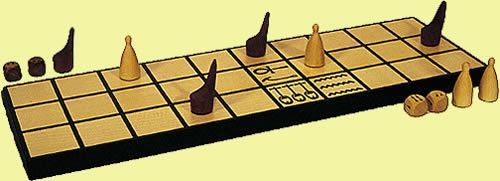
This is the third in the Pharao-Brettspiele series of games, the other two being Isis and Ramses. The board is an Ancient Egyptian Senet board, and the game can be played as such if one supplies the throwing sticks (randomizing devices that eventually evolved into dice; available in commercial Senet sets or easily home-made). Note, however, that there are only 4 pieces per player instead of the almost-standard 5 (historically, the number of pieces per player varied between 5 and 10), so a fifth piece would ideally need to be supplied. H. A. Renz chose, once more, to use the components for an entirely different, modern abstract strategy game. Each player uses two special dice to move both his pieces and his adversary's (this is the only game of the triad to have a random element). The object of the game is to either "push" all adversary pieces into the water (a special square), occupy the "happiness" square with one's last remaining piece, or box the adversary in so he cannot move. Note how driving towards one victory condition (by adversary elimination) actually opens up a victory opportunity for the adversary --a neat twist. Remarkably, the starting position is asymmetric because the board is asymmetric. There does not seem to be much of an advantage or handicap to being one side or the other.
Filed Under
- Categories
- Mechanics
- BGG ratings
- 19