Location
Sign in to see where your copy sits: the shelf, drawn, and how the box sits on it.
My Copy & Notes
My Prints for Quadryx
All 0 on LayerUpSign in to see the prints you marked Printed for this game, the insert in the box first.
Expansions & Promos
No expansions or promos on record for this game.
About the Game
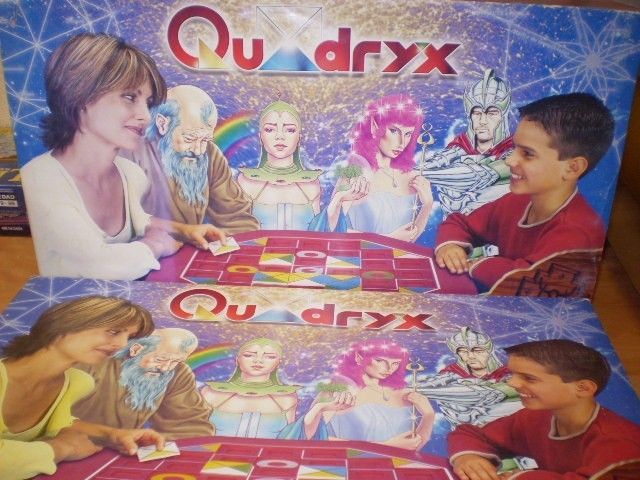
Quadryx is defined as a "logic game of strategic control". It's an abstract game played by 4 players on an octogonal game board divided in 37 square spaces. Each player has a group of 9 square tiles, each divided in 4 triangles of different colors. Each player will be represented by a one color, and the goal of the game is building squares (quadryx) by joining two triangles of the same color, while trying to make it difficult for the other players to do the same. The one who builds the most quadryx wins.
It's also possible to build a fulldryx, which is 4 quadryx of the same color joint together. If there is a tie on the number of quadryx, the winner is the one with most fulldryx.
Quadryx (also known as Qryh) is an ancient game whose origins go back to the 11th century. It was brought back thanks to spanish teacher and researcher Antonio José López,who spent almost 25 year gathering information from historical documents about a similar game from the Escuela de Estudios Talmúdicos de Lucena (Spain), where Jews, Christians and Moors took part equally.
According to the researcher, there is historical evidence of its presence on Lucena's nobles' homes around 1100. Later, the game re-appears on El Cairo, where the greek sailor Saulo de Quirón finds it and gives it as a present to King Alhamar of Granada (Spain), who gave it to his concubines from the Alhambra's harem. It stood there from 300 years until the kingdom fell in christian hands. In 1501, Abraham Cohen, a convert merchant from Lucena found it in Granada's Aljaba, and remembered seeing it when he was young, so he took it back to Lucena. From that moment on, the game's trail was lost.
It was first brought back on May 2001, and it was later launched internationally by Famosa on 2002.
Filed Under
- Categories
- BGG ratings
- 14
- BGG data
- refreshed Sep 6, 2026