Quarto 1950
Location
Sign in to see where your copy sits: the shelf, drawn, and how the box sits on it.
My Copy & Notes
My Prints for Quarto
All 0 on LayerUpSign in to see the prints you marked Printed for this game, the insert in the box first.
Expansions & Promos
No expansions or promos on record for this game.
About the Game
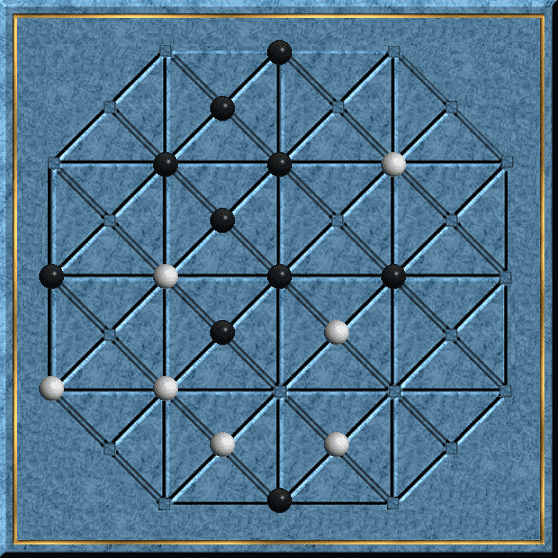
The game consists of two phases, a placement phase followed by a movement phase. The two players White and Black each have twelve pieces.
PLACEMENT PHASE: Beginning with White, the players alternate placing one of their twelve pieces on one of the 37 crossing points on the board. Once all pieces have been placed, the movement phase begins. A piece can be captured during this phase (see below).
MOVEMENT PHASE: The players alternate moving one of their pieces to an adjacent and empty crossing point. A piece can be captured during this phase (see below). If a player has only 4 remaining pieces, they are allowed to move their piece to any empty crossing point.
QUADRATES: A quadrate occurs when a piece is placed such that the 4 corners of a square are occupied by that player's pieces. Quadrates come in 6 different sizes. To form a quadrate, a player must have their pieces on all 4 corners of a square composed of either 2,4,8,16,18, or 32 triangles.
The table below indicates the number of possible quadrates composed of a given number of triangles:
No. of Triangles/No. of Quadrates 2 - 24 4 - 12 8 - 13 16 - 5 18 - 4 32 - 1
For any of the larger quadrates (8,16,18,32), the quadrate is invalid if there is an opposing piece on any position along the side.Only friendly or empty positions are allowed along the edges (sides) of a quadrate.
CAPTURE: If after placing a piece, a quadrate is formed, the player can remove an opponent piece which does not itself form a quadrate with 3 other pieces.
Once a player has only 3 remaining pieces, they lose the game. If the same position occurs 3 times, then the game is declared a draw.
Notes: o In rare cases, all of a player's pieces may be trapped thus requiring the player to pass. o Danish Quarto has some similiarities to the Morris family of European board games, but also shares important features of a Chinese game named `Fang`
Filed Under
- Categories
- Mechanics
- Also known as
- Danish Quarto
- BGG ratings
- 20
- BGG data
- refreshed Sep 6, 2026