Sapos 2012
Location
Sign in to see where your copy sits: the shelf, drawn, and how the box sits on it.
My Copy & Notes
My Prints for Sapos
All 0 on LayerUpSign in to see the prints you marked Printed for this game, the insert in the box first.
Expansions & Promos
No expansions or promos on record for this game.
About the Game
Overview Sapos is a two-player abstract strategy game played on an 8×8 grid of points. Players jump their stones over adjacent stones — friend or foe — capturing enemy pieces they leap over and advancing new reinforcements from reserve. There is no passing: every legal turn moves the game forward, and a player who runs out of ways to make progress loses.
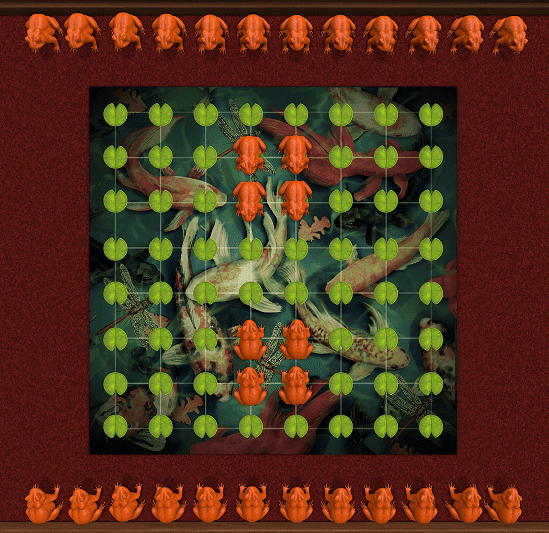
Players & Materials • 2 players. • A board of 8×8 points, labeled by column (a–h) and row (1–8), like a chessboard's coordinates but referring to intersections rather than squares. • 32 stones total — 16 per player. One player's stones are traditionally orange, the other green.
Setup Each player begins with 4 stones on the board and 12 in reserve. Orange (Player 1): d2, d3, e2, e3 Green (Player 2): d6, d7, e6, e7
The two starting formations mirror each other across the board's center row. All remaining stones — 12 per player — stay off the board in reserve until spawned in (see Spawning, below).
Who goes first (pie rule) Before each round, one player — the chooser — decides who moves first. The role of chooser alternates each round, so over a multi-round match neither player can lean on the small edge that comes with moving first.
Objective Be the last player able to make a legal move. A player loses the moment any of these is true at the start of their turn: • They have no legal jump available at all, or • They have no capturing jump available, and no stones left in reserve to spawn, or • The exact same position (same board, same reserves, their turn to move) has now occurred for the third time — see Repetition, below.
The second condition matters: once your reserve is empty, an ordinary non-capturing hop is no longer enough to survive your turn on its own — you need a capture to keep going. This keeps the game from stalling out in an endless, aimless shuffle.
Definitions Adjacent — Two points are adjacent if they are directly next to each other orthogonally (up, down, left, or right). Diagonals do not count.
Jump — A stone jumps over an adjacent stone — friendly or enemy — landing on the empty point directly beyond it, in the same direction.
Capture — Jumping over an enemy stone captures it. The captured stone is removed from the game permanently; it does not return to its owner's reserve.
Jump sequence — A single turn's worth of jumping. A sequence is one jump, or a chain of several jumps made in succession by the same stone.
Reserve — Stones not yet on the board. Reserve stones enter play only through spawning.
Playing the Game Players alternate turns. On your turn you must make one full jump sequence — there is no option to pass.
1. Mandatory capture If any of your stones has a capturing jump available at the start of your turn, you must make a capturing jump. You may not choose a quieter, non-capturing move while a capture is on the table. If more than one capture is available, you choose which stone — and which capture — to play.
2. Keep capturing (captures only) A jump sequence is not limited to one hop. If you're capturing, you must keep capturing while another capture is available — you may not break off into a quiet hop instead, and you may not stop early. A capturing sequence only ends when no further capture is available from where you've landed.
• A non-capturing (friendly) hop is different: after it, you may choose to continue with another available jump, or stop there voluntarily. Continuing further is always optional for a friendly hop — only captures are ever mandatory to continue. • If a capture becomes available partway through a friendly-hop sequence, it immediately becomes mandatory — you must take it, even if you'd rather keep hopping quietly or stop. • A stone may not land on a point it has already occupied earlier in the same turn's sequence. • Whether a given jump is over a friendly or an enemy stone, the destination point must be empty.
3. Spawning If your whole sequence ended without capturing any enemy stones, you automatically bring one stone in from reserve — placed on the point immediately beyond where your moved stone ended, on the side facing your opponent. This happens automatically, without spending an extra action, whenever you have a reserve stone available and that forward point is open.
• Spawns always advance the front line. A new stone can never be placed behind or beside where you ended — only on the point that faces the opponent's side of the board. • If you have no reserve left, or the forward point is occupied, no stone is spawned and your turn simply ends. • A sequence that included any capture never spawns, even if it also included non-capturing hops earlier in the same chain.
4. Repetition If the exact same position — identical board, identical reserves, and the same player to move — occurs for the third time, the game ends immediately. The player who is about to move into that repeated position loses; their opponent (who just moved) wins.
• This only ever fires on genuine, exact repetition — it never affects an ordinary turn that merely resembles an earlier one. • In practice this is rare. It exists purely as a backstop: it guarantees the game can never truly loop forever, even in an unusual position where a pair of stones could otherwise shuttle back and forth indefinitely.
Filed Under
- Categories
- Mechanics
- BGG ratings
- 3
- BGG data
- refreshed Sep 6, 2026