Tanbo 1993
Location
Sign in to see where your copy sits: the shelf, drawn, and how the box sits on it.
My Copy & Notes
My Prints for Tanbo
All 0 on LayerUpSign in to see the prints you marked Printed for this game, the insert in the box first.
Expansions & Promos
No expansions or promos on record for this game.
About the Game
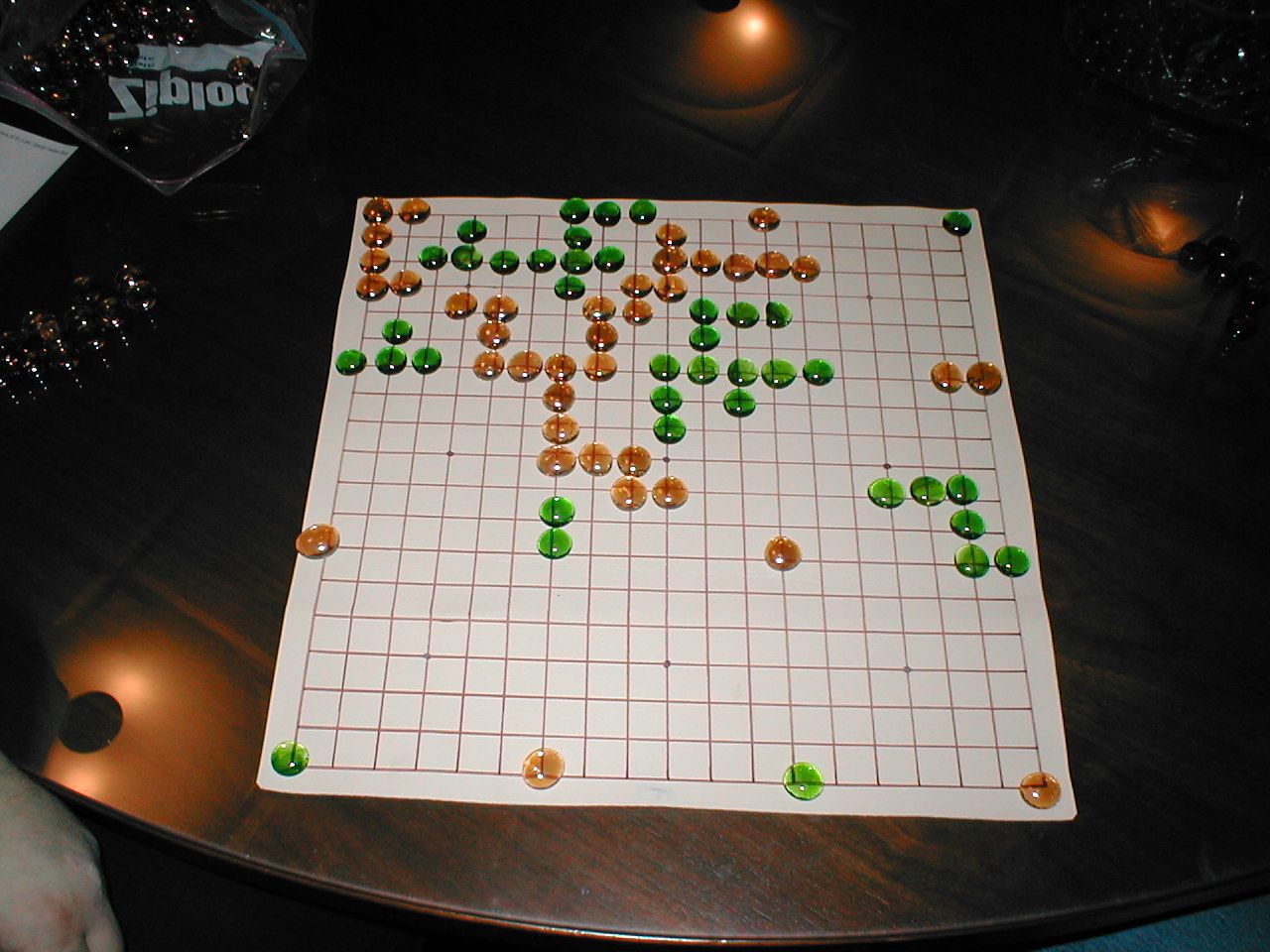
Tanbo (Japanese for "rice paddy") is played on a grid of size 7x7, 11x11, 15x15... Or 5x7, 7x9, 9x11, 11x13... The board is initially populated with black and white stones, thoroughly interspersed, with one empty point (intersection) between stones.
The two players, Black and White, take turns placing stones of their own color onto unoccupied points on the board, one stone per turn, starting with Black. You must place your stone orthogonally (horizontally or vertically) adjacent to exactly one of your on-board stones. [All relevant adjacencies here are orthogonal.]
Roots and capturesA "root" is root-like, monocolored group, which could be a single stone. The game begins with a fixed number of roots. Roots cannot merge together, and new roots cannot be created. The "current root" is the root which you enlarged during your current turn.
A root is “bounded” if it’s so tightly surrounded that it doesn’t have room to grow. There are no legal placements available that would enlarge the root. [More technically, there is no unoccupied point which is adjacent to exactly one stone in a bounded root and which is not adjacent to any other stones of the bounded root's color.]
If your placement has bounded your current root, you must immediately remove your current root from the board, concluding your turn.
If your placement has not bounded your current root, but has bounded other roots, of either or both colors, you must immediately remove all of the roots that were so bounded, concluding your turn.
Object of the gameThe goal is to annihilate your opponent. When all of the roots of one color have been removed, the player of the other color wins. You can win on either player's turn.
Design notesTanbo was the second game I ever designed, back in 1993. It originally had a much sparser initial position, having only 16 stones on a size 19 board. Now in 2026, I'm re-releasing Tanbo, with a much denser initial position, but otherwise exactly the same rules. This creates more fluid, less stilted gameplay. Tanbo is a classic. It's been bastardized, butchered, and debased. But never equaled.
Filed Under
- Categories
- Mechanics
- Also known as
- Rootbound
- BGG ratings
- 35 · geek rating 5.50
- BGG data
- refreshed Sep 7, 2026