Location
Sign in to see where your copy sits: the shelf, drawn, and how the box sits on it.
My Copy & Notes
My Prints for Tipping Point
All 0 on LayerUpSign in to see the prints you marked Printed for this game, the insert in the box first.
Expansions & Promos
No expansions or promos on record for this game.
About the Game
A semi-abstract, cooperative game designed to teach project management techniques.
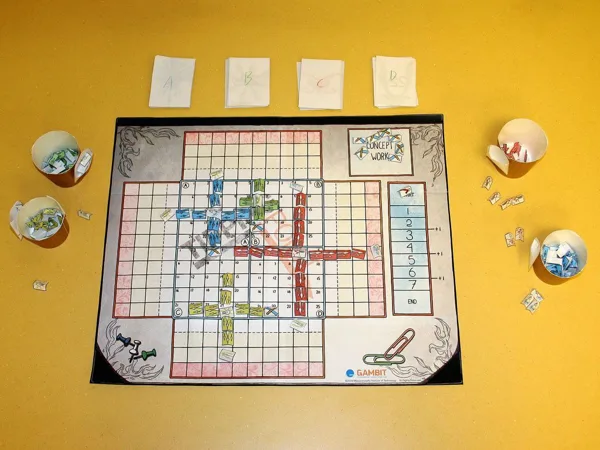
The game takes place on an 18x18 grid. The players take the role of project managers in a company. At the start of the game each player has a single project in play. Projects begin in a single space on the board, and each turn grow out one space orthogonally in all directions. On a player's turn only his or her projects grow.
If a project grows into the edge of the board, the game ends in a loss for all players.
To finish projects, players utilize a mix of concept work and production work tokens. Placing a token on the board blocks projects from growing into that space. If a project cannot grow it counts as finished, and the players score one point. After a project is completed, a replacement is added in a semi-random square.
Concept work tokens are taken from a shared pool of 10, and once placed remain in play indefinitely.
Additionally, each player has 2 production work tokens. These tokens only last for one round.
A player's turn consists of doing one of the following: placing a single concept work token, moving a single concept work token, or placing both production work tokens.
That player then grows his or her projects. If two (or more) projects collide they combine into a single compound project. Compound projects grow on the turns of every player who has a project involved, and their multiple growth points make them much harder to finish. Additionally, compound projects are still only worth a single point.
The players win if they can finish eight projects. However, after every other project is finished, another project is added to the mix. This means that the end game requires managing seven projects simultaneously.
Designed by a team at the Singapore-MIT GAMBIT Game Lab for the MIT Sloan School of Management.
Filed Under
- Categories
- Mechanics
- BGG data
- refreshed Sep 7, 2026