Log in to join the conversation.
Large modular Aggravation / Tock / Ludo / Pachisi board
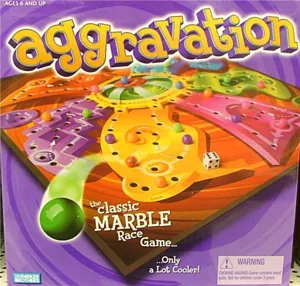
Tock is a board game, similar to Ludo, Aggravation or Sorry!, in which players race their tokens (or marbles) around the game board from start to finish—the objective being to be the first to take all of one's tokens "home". Use standard sized marbles (@ 14mm) as game tokens, and a standard deck of cards.
This modular board allows many variations for four or more players:
- 3, 4 or 5 token variants, for shorter or longer play
- Individual player variants: 4x1 (1v1v1v1); 5x1; 6x1 etc.
- Teams variants: 2v2; 3v3; 2v2v2; etc.
A really simple print: it has predesigned supports for the only overhang, so can be printed without further supports. I used a brim, but it's probably not necessary.
When the printing is complete, use a pair of pliers or a sharp knife to remove the built-in supports under the end overhang. A deburring tool will help clean any brim.
You will need a minimum of 4 pieces to play: the pieces will not rotate far enough for a 3 player version.
You could try playing with pausing the print to create colors in the marble holes, but it's just easier to use a permanent marker pen, or a dab of paint, once the print is finished.
Lots of rule variations, but this is one popular way to play:
At the beginning of each round players are dealt a number of cards which they play in turns to move their tokens around the board. If at any time a token lands exactly on the field occupied by another token then the moved token replaces the resting one (which is placed back into the corresponding player's starting area). If a player on their turn has no cards they can play with their tokens (or which they can't play against the other players, in some variations) then they must discard their entire remaining hand and wait for the next hand to be dealt. The discarded cards may not be looked through by other players.
A starter is a card that allows a player to move a new token to the starting field. Aces and Kings (and Jokers in some variations) are starters.
A token at the starting field is immune to capture or swapping by an opponent, and additionally it creates a blockade. No players can pass a token that is on its starting field, either forward or backwards (with a 4) with the exception of a Joker in some variations.
In the simplest form of the game, the cards only provide a single specific number of fields to move forward. However, Tock has many (even more popular) variations where some cards have special functions, that make the game more challenging and interesting.
Any combination of card functions can be used in play. Just ensure every player is aware of all the options to be used in play prior to the game.
To make it "home", a player needs the exact count of fields, and they need to fill the house from the top down. Tokens are not allowed to jump over other tokens within the house.
The basic functions of cards are:
Ace: Can be used as 1, or as a starter.
Jack: Makes a move of 11 fields, or as a switcher.
Queen: Makes a move of 12 fields.
King: Can be used to move 13 fields after all tokens are out, or as a starter.
The following are also commonly used:
4: Move four fields backward . Players are allowed to go backward from their starting point and then into Home on a subsequent turn. But moving backward straight into Home is not allowed.
7: Make 7 individual moves of one field. These moves can be freely distributed among all of his tokens. These moves can destroy everything in the player's path.
Jack: Make a move of 11 fields or may swap one of his own tokens with any other token (opponent's or his own) on the circle track.
Aside from a "Free for all" play style the game also supports a variety of team based modes. Common to all team based variations is that once a team member has managed to bring all of his tokens home he helps move his partners' tokens. If the first player to get all marbles home plays a seven, the remainder can be used to move the partners marbles. Also after every hand is dealt the team members exchange one card with each other.
- Two versus two players standard - Players on opposite sides of the board team up.
- Three versus three players - On a six player board the teams' players are placed in alternating order around the board. Each team member exchanges card with every other team member when a new hand is dealt.
- Two versus two players extended - On a six player board each team will receive an additional common color of tokens. The teams are placed like in a 3 vs 3 game. Each player may move with his own or the common color.
- Two vs. Two vs. Two players - Players on opposite sides of the board team up. This variant is more "cutthroat" than the other team based variants because there are more hostile turns than friendly turns in every round.
- Three vs Three with captains - Players on opposite sides of the board team up, along with a captain, on a 4 player board. The non-captains play their own pieces, while the captain can play either of their teammate's pieces. Should a teammate complete, they then join the captain to play the remaining teammate’s pieces.