Log in to join the conversation.
Goblin Night Market — a print-and-play board game for PlayGrid
Roll, move round a loop, buy the stall you land on, pay whoever got there first. Same shape as the game everyone knows, cut to half an hour and stripped of the slog: no debt, no mortgages, no auctions, no trading, nobody knocked out, and no single payment above 3 coins.
You collect reputation, not money. Hoarding pays 1 point per 4 coins at the end, upgrading a stall pays 1 point for 2 coins now, so the miser loses.
Know what you are getting: a light, luck-forward family game. The die decides where you go; you decide only whether to spend. It is the game you put in front of children and relatives, not a strategy game.
Best with four players. Three game lengths, agreed before setup: 8 rounds (15-20 min), 12 rounds (20-30 min, standard), or 16 rounds (35-45 min).
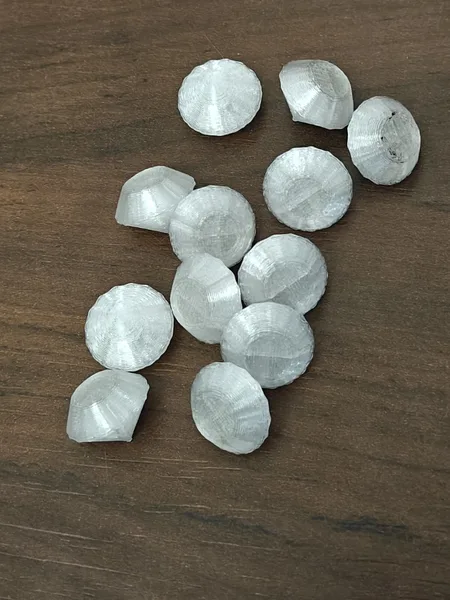
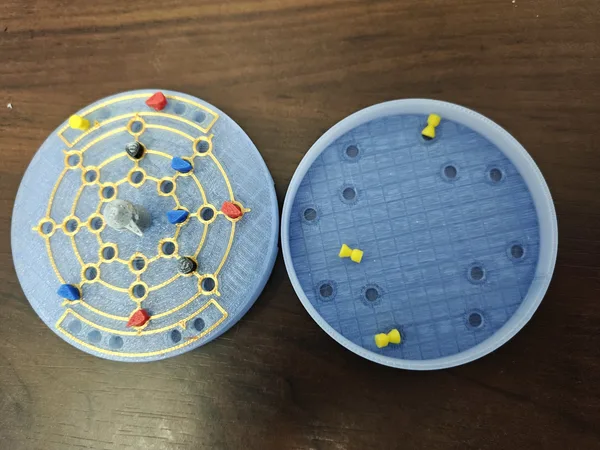
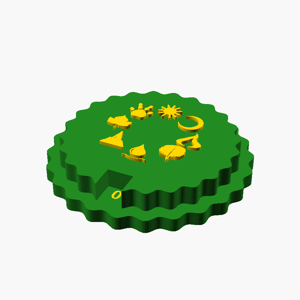
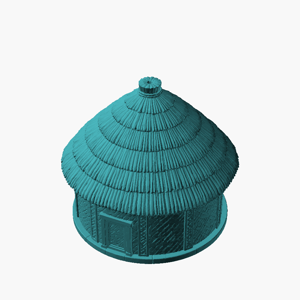
WHAT YOU PRINT - about 100 pieces from ~35 distinct geometries: 36 route tiles, 24 stall facades, 24 reversible owner signs, 4 goblin pawns, 4 dashboards with pegs, two custom dice, the Moon Market dial, and a two-part sorting box. Plays on the PlayGrid 10 x 10 board; a printable board is included so it stands alone.
Most parts have a single-colour and a two-colour version. The two-colour files carry the inlay as a second named solid: import, right-click, Split to Parts, assign two filaments. Print those instead of the plain file. Everything is legible in one colour too.
Rules booklet in ten languages plus an illustrated assembly guide are attached. Narrated rules and full playthrough: https://youtu.be/bYMRf7FR1q4
Not sure it is your kind of game? Goblin Night Market has a free digital version: the same loop, the same stalls and rules, against goblin bots or friends at one screen. One game there tells you whether it is worth printing a hundred pieces: https://morassgames.com/games/goblin-night-market/
- Players: 2–4 — best at 4
- Age: 8+
- Time: 20–30 minutes (the standard 12-round market)
- Rules weight: 2 / 5 — one page, no hidden information, no upkeep
- Reading needed: none on the components — districts read by colour and icon
Play it with four. At four players 13 of the 24 stalls get bought and four of the six districts end up contested; at two, only 7 and 1.5, and the paying-a-rival economy barely fires. Three players leaves one corner Gate empty and carries a measured ~3-point positional bias toward whoever reaches that un-homed quarter first.
More stars means more of the named thing - never "better". Every row names both ends, so nothing here needs a legend.
- Luck ★★★★☆ - 1 = your choices decide it; 5 = the dice decide it
- Depth ★☆☆☆☆ - 1 = best play fits in one sentence; 5 = years to learn
- Player interaction ★★★☆☆ - 1 = solitaire side by side; 5 = every turn changes everyone's
- Swing ★★★★☆ - 1 = the leader stays the leader; 5 = anyone can come back
- Waiting between turns ★★☆☆☆ - 1 = almost no waiting; 5 = long gaps between your turns
- Replayability ★★☆☆☆ - 1 = identical every time; 5 = a new game each play
- Rules weight ★★☆☆☆ - 1 = taught in a sentence; 5 = a 40-page manual
- Memory needed ★☆☆☆☆ - 1 = nothing to remember; 5 = constant recall
- Reading needed ★☆☆☆☆ - 1 = no text at all; 5 = unplayable without the language
- Child-readiness ★★★★☆ - 1 = adults only; 5 = a three-year-old can play
- Setup time ★★★☆☆ - 1 = laid out in a minute; 5 = a long build every game
- Print effort ★★★★☆ - 1 = a couple of parts; 5 = a hundred-plus pieces
- Table presence ★★★★★ - 1 = flat tokens; 5 = a centrepiece people stop to look at
More by Miloslav Brožek