Log in to join the conversation.
Harbour Light — pocket board game in a box that is the board
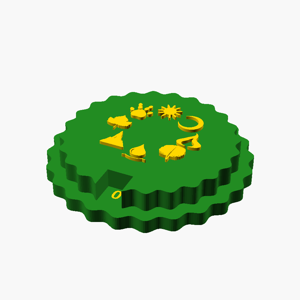
A pocket board game for two, in a box that IS the board. A round Ø82 mm box. Its lid is a small polar sea — three rings, eight spokes, a lighthouse standing in the middle. The light moves one spoke at the end of every turn, and a boat may steer toward the centre only while its own spoke is lit. Bring two of your three boats home and you win.
Watch it played — the rules from scratch, then a complete 40-turn game:
Two people, ten to fifteen minutes, from about eight years old. It is a clean abstract with no dice and no hidden information — if you want a game of luck and swings for a family evening, this is the wrong one. Best play is not hard to find, either: the depth here is shallow on purpose, and the fun is in the timing.
- The box is the board. Nothing to unfold, nothing to lose. Ø82 mm closed, and it goes in a coat pocket.
- Every piece is a peg, and every peg has a hole to stand in. On the lid they stand in the cells; inside the base they stand in the floor. A closed box holds nothing loose and does not rattle.
- No text anywhere on the board. Rings, spokes and a pointer — it plays in any language.
- One plate, about 46 g, no supports, no hardware, no glue.
On your turn you do exactly one thing:
- Launch — a new boat onto any empty place of the outer ring.
- Sail — one boat one place around its own ring, either way.
- Steer in — one boat one ring toward the middle, and only while that boat's spoke is lit.
- Stoke — spend one of your two oil pieces; the light moves an extra spoke at the end of this turn.
Then the lighthouse clicks one spoke clockwise. Steering inward from the innermost ring docks a boat in your harbour, and two docked boats end the game at once.
The whole game lives in one observation: the light moves one spoke per turn and there are two of you, so on your turns it only ever reaches every second spoke. Four spokes are yours and four are your rival's — and a stoke swaps the two sets. That is what the two oil pieces are for.
file
qty
what it is
lid.stl
1
the board — the lid of the box
lid_2c.stl
—
the same lid in two colours (see below), print instead
body.stl
1
the base, which stores every piece
cap.stl
1
the lighthouse
boat.stl
6
three per sailor
rock.stl
2
the two grey rocks
oil.stl
4
two per sailor, flame-topped
pegs.stl
—
all fifteen pieces on one plate, instead of the four above
Two colours: print lid_2c.stl instead of lid.stl and use Split to Parts in Bambu Studio. The rings, spokes, cell eyelets and quay brackets come back as ONE second-colour part, and it sits in the first four layers — so the purge cost is small.
- RULES.pdf — a nine-page illustrated booklet; every rule has a picture of the board beside it.
- ASSEMBLY.pdf — what to print, in what order, and what to check.
- harbour_light_docs_10_languages.zip — the same rules booklet in English, German, French, Spanish, Italian, Portuguese, Czech, Slovak, Polish and Chinese . The English decides; the rest are machine translations, typeset to the same booklet.
Players
2
Age
8+
Time
10–15 minutes (about 40 turns, 20 each)
Rules weight
1 / 5 — four actions, one condition: steer in only when lit
Reading needed
none — rings, spokes and a pointer
There are no dice. The beam's start and two player-placed rocks are the whole opening; everything after is open information. Random play won 1 of 300 games against a competent sailor; three-ply play beats competent play 80 % of the time ; replaying the same opening with one seat swapped good→random changes the winner in half the games. Moving first is worth about 61 / 39 against an equal engine, and that edge does not grow as both sides search deeper (57–62 % from one to six ply), so play two games and swap seats. Measured L = 0.69.
More stars means more of the named thing — never "better". Every row names both ends, so nothing here needs a legend.
Luck
★☆☆☆☆
1 = your choices decide it; 5 = the dice decide it
Depth
★★☆☆☆
1 = best play fits in one sentence; 5 = years to learn
Player interaction
★★★★☆
1 = solitaire side by side; 5 = every turn changes everyone's
Swing
★★★☆☆
1 = the leader stays the leader; 5 = anyone can come back
Waiting between turns
★☆☆☆☆
1 = almost no waiting; 5 = long gaps between your turns
Replayability
★★☆☆☆
1 = identical every time; 5 = a new game each play
Rules weight
★☆☆☆☆
1 = taught in a sentence; 5 = a 40-page manual
Memory needed
★☆☆☆☆
1 = nothing to remember; 5 = constant recall
Reading needed
★☆☆☆☆
1 = no text at all; 5 = unplayable without the language
Child-readiness
★★★☆☆
1 = adults only; 5 = a three-year-old can play
Setup time
★☆☆☆☆
1 = laid out in a minute; 5 = a long build every game
Print effort
★☆☆☆☆
1 = a couple of parts; 5 = a hundred-plus pieces
Table presence
★★☆☆☆
1 = flat tokens; 5 = a centrepiece people stop to look at